GHG Accounting Explained: Scope 1, 2, and 3 Emissions
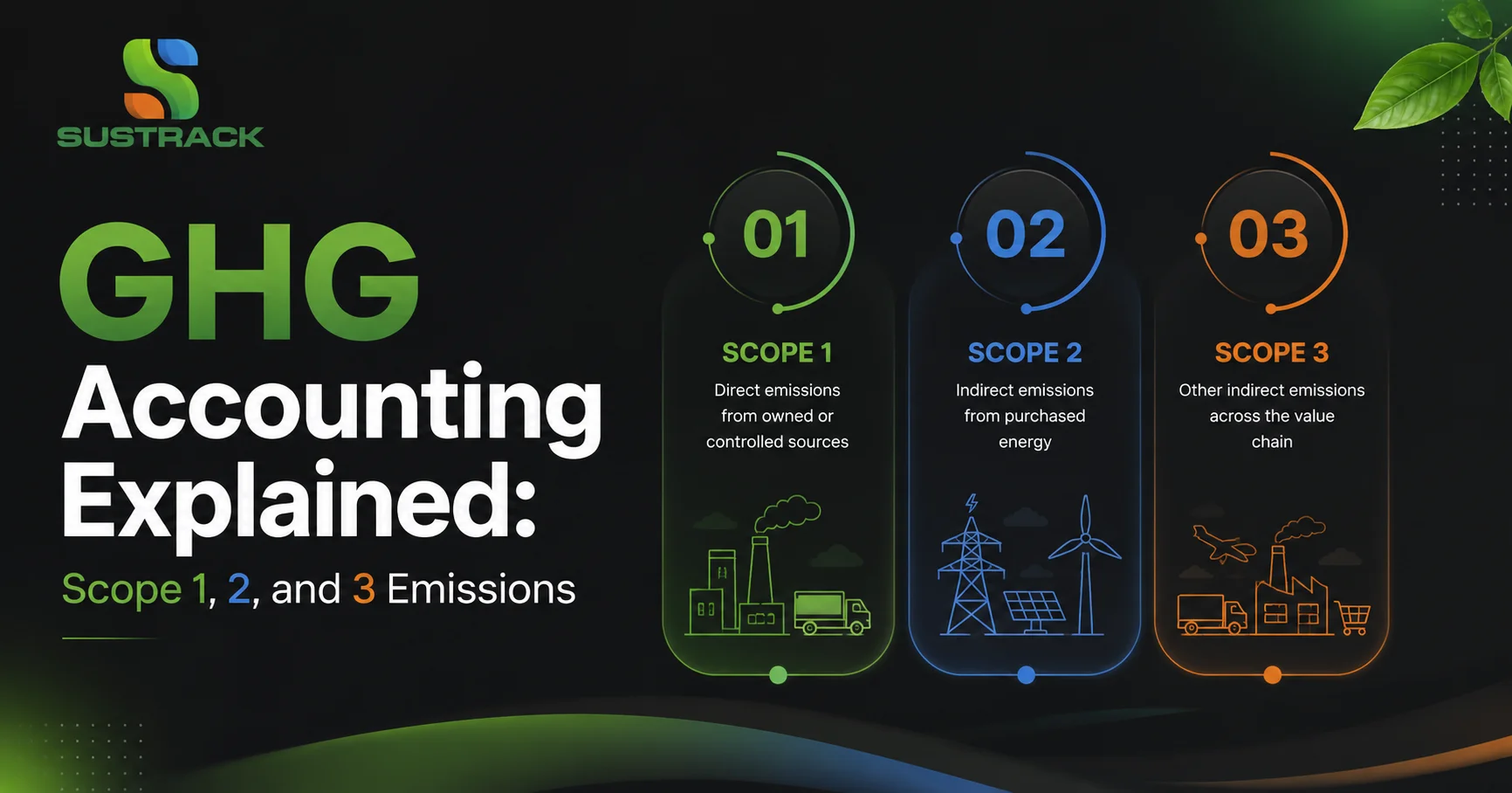
GHG accounting helps companies measure and track their environmental impact through scope 1 2 3 emissions. At Sustrack, we help businesses understand and manage greenhouse gas emissions more effectively.
GHG accounting explains how much carbon a company produces from direct operations, purchased electricity, and supply chain activities. Understanding scope 1 2 3 emissions helps businesses improve sustainability, reduce environmental impact, and meet growing ESG reporting requirements.
Definitions of Scope 1, 2 and 3 Emissions
GHG accounting helps businesses measure greenhouse gas emissions from different business activities. In simple terms, scope 1 2 3 emissions explain where carbon emissions come from and how companies can reduce them using proper carbon accounting methods.
Scope 1 Emissions : Scope 1 emissions are direct emissions produced from sources owned or controlled by a company. These emissions mainly come from fuel burning, company vehicles, generators, factories, or industrial equipment. For example, diesel used in company trucks creates scope 1 emissions.
Scope 2 Emissions : Scope 2 emissions are indirect emissions created from purchased electricity, heating, or cooling used by a business. Although the company does not produce the electricity itself, it is responsible for the emissions generated during electricity production. Proper GHG accounting helps companies track these emissions accurately.
Scope 3 Emissions : Scope 3 emissions are indirect emissions linked to the company’s value chain. These emissions come from suppliers, transportation, product usage, employee travel, and waste disposal activities. Scope 3 is usually the largest category in scope 1 2 3 emissions and is important in advanced carbon accounting methods.
How to Reduce Your Company’s Scope 1, 2, and 3 Emissions
Reducing scope 1 2 3 emissions is important for businesses that want better sustainability and lower carbon emissions. Proper GHG accounting helps companies identify pollution sources and apply effective carbon accounting methods for long-term environmental improvement.
Scope 1 Emissions Reduction : Scope 1 emissions come directly from company operations such as fuel combustion, generators, factories, and company vehicles. Businesses can reduce these emissions by replacing old high-emission equipment with cleaner alternatives, switching to low-emission fuels, improving energy efficiency, reducing fuel use in company vehicles, and generating renewable energy on-site through solar systems or other clean energy sources.
Scope 2 Emissions Reduction : Scope 2 emissions are linked to purchased electricity, heating, and cooling used by businesses. Companies can lower these emissions by improving energy efficiency, using energy-saving equipment, purchasing renewable electricity, installing on-site renewable energy systems, implementing energy management systems, and reducing transmission and distribution losses through better energy practices.
Scope 3 Emissions Reduction : Scope 3 emissions include indirect emissions generated across the company’s value chain, including suppliers, transportation, business travel, employee commuting, and waste management.
Businesses can reduce these scope 1 2 3 emissions by purchasing low-carbon materials, working with suppliers to reduce emissions, improving transportation efficiency, encouraging video conferencing instead of frequent travel, supporting remote working and public transport, and improving recycling and waste reduction practices.
Proper GHG accounting and advanced carbon accounting methods help companies track and reduce these indirect emissions effectively.
How to Calculate Scope 1 2 3 Emissions?
Scope 1
Calculating Scope 1 emissions using carbon accounting methods involves measuring direct greenhouse gas emissions from company-owned sources under the greenhouse gas protocol. The process is done step by step as follows:
Step 1: Identify emission sources : First, the company identifies all direct emission sources such as boilers, furnaces, generators, company vehicles, industrial processes, and refrigerant leaks from cooling systems.
Step 2: Collect activity data : Next, the company gathers activity data like fuel consumption, vehicle mileage, operating hours of machinery, and usage records of equipment like boilers and generators.
Step 3: Select emission factors : Then, appropriate emission factors are chosen from recognized sources such as the greenhouse gas protocol, IPCC, EPA, or national greenhouse gas inventory databases.
Step 4: Apply the calculation formula : Finally, emissions are calculated using the standard formula: emissions = activity data × emission factor. This forms the basis of emissions reporting for Scope 1.
Scope 2
Scope 2 emissions calculation focuses on indirect emissions from purchased energy under carbon accounting methods and the greenhouse gas protocol.
Step 1: Identify energy sources : Companies first list all purchased electricity, steam, heating, and cooling used in operations.
Step 2: Measure energy consumption : Next, they measure total electricity consumption in kWh along with other purchased energy usage.
Step 3: Select emission factors : Emission factors are selected based on regional electricity grids and greenhouse gas protocol guidelines.
Step 4: Apply the calculation formula : Emissions are calculated using: emissions = electricity consumption × emission factor. This supports accurate emissions reporting for Scope 2.
Scope 3
Scope 3 emissions calculation is the most complex part of emissions reporting under carbon accounting methods and the greenhouse gas protocol.
Step 1: Identify emission categories : Companies identify all relevant Scope 3 categories such as purchased goods, transportation, waste, business travel, employee commuting, product use, and investments.
Step 2: Collect activity data : Next, detailed data is collected from suppliers, logistics partners, internal departments, and operational records across the value chain.
Step 3: Select emission factors : Suitable emission factors are chosen from recognized databases like IPCC, EPA, and greenhouse gas protocol resources.
Step 4: Apply calculation formula : Finally, emissions are calculated using: emissions = activity data × emission factor. This ensures complete emissions reporting across the value chain.
Why Choose Sustrack for GHG Accounting & Emissions Reporting?
GHG accounting, scope 1 2 3 emissions, carbon accounting methods, and greenhouse gas protocol–based emissions reporting are becoming essential for every business focused on sustainability and compliance. At Sustrack, we simplify the entire process of emissions measurement and reporting by helping organizations understand, calculate, and manage their carbon footprint across all three scopes.
Our services include ESG reporting, BRSR reporting, ESG consultancy, and CDP reporting, ensuring complete alignment with global and Indian regulatory frameworks.
From defining emission scopes to implementing accurate calculation methodologies and building reliable data collection systems, we support businesses at every stage of their sustainability journey and help them achieve transparent, audit-ready emissions reporting.
Frequently Asked Questions
What is GHG accounting in simple terms?
GHG accounting is the process of measuring and tracking greenhouse gas emissions produced by a company through its operations, energy use, and supply chain activities.
Why is emissions reporting important for businesses?
Emissions reporting helps companies meet ESG requirements, improve sustainability performance, comply with regulations, and reduce their overall carbon footprint.
What is the greenhouse gas protocol?
The greenhouse gas protocol is a global standard that provides guidelines for measuring and managing scope 1 2 3 emissions in a consistent and transparent way.
Which scope is the most difficult to measure?
Scope 3 emissions are the most complex because they include indirect emissions from suppliers, transport, product use, waste, and other value chain activities.