ESG Reporting Frameworks: BRSR vs GRI vs SASB
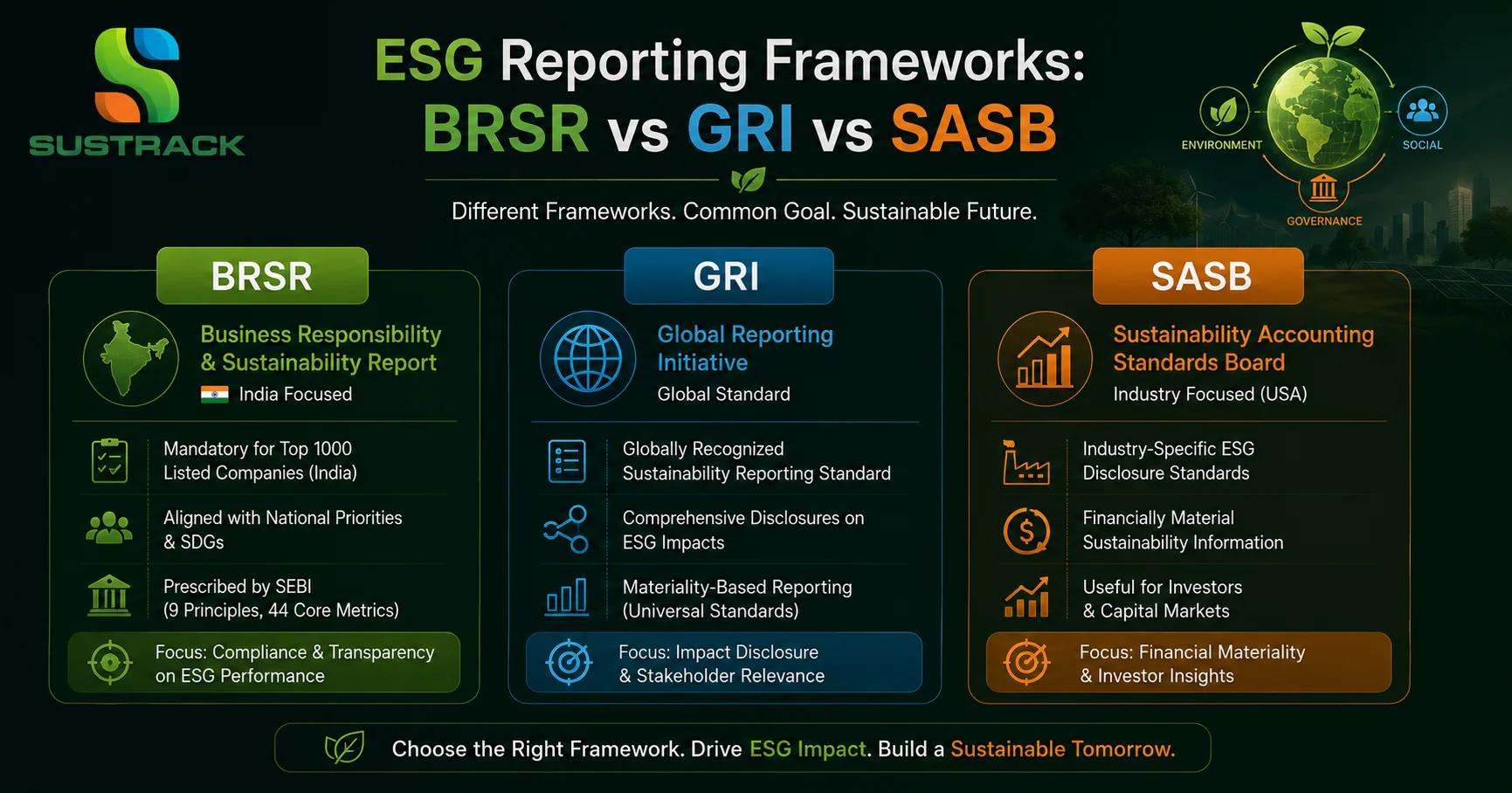
BRSR vs GRI is an important topic in sustainability reporting standards for modern businesses. ESG reporting frameworks help companies measure and share their environmental, social, and governance performance in a clear way. Among the most used sustainability reporting standards are BRSR, GRI, and SASB, each designed to guide companies in different reporting needs.
BRSR is mainly used in India, while GRI is widely accepted globally, and SASB focuses on industry-specific financial impact. Understanding these frameworks helps businesses choose the right reporting system and improve transparency with investors and stakeholders.
What Is ESG Reporting?
BRSR vs GRI is important in understanding modern ESG reporting standards used by companies worldwide. At its core, ESG reporting is the disclosure of environmental, social, and corporate governance data.
This approach allows companies to clearly communicate their commitment to sustainability and responsible business practices to stakeholders, including investors, customers, and regulators.
ESG reporting goes beyond financial metrics, as it provides insight into a company’s overall impact on society and the environment. BRSR vs GRI also helps businesses understand different reporting requirements, where BRSR is focused on Indian regulatory compliance while GRI is widely used for global sustainability disclosures.
By sharing ESG performance data through these frameworks, companies build trust, transparency, and stronger credibility with all stakeholders.
Types of Sustainability Reporting Standards
There are many sustainability reporting standards used by companies across the world. Because there is no single reporting system, businesses often face challenges while choosing the right framework.
This is why topics like BRSR vs GRI, ESG disclosure frameworks, and global ESG standards have become very important for companies, investors, and regulators.Over the years, many reporting systems have merged or aligned with each other to improve consistency and transparency.
Today, companies can select different ESG disclosure frameworks based on their industry, reporting goals, and legal requirements. Some frameworks focus on financial risks, while others focus on environmental and social impact.
IFRS Sustainability Disclosure Standards : The IFRS Sustainability Disclosure Standards were introduced in 2023 by the International Sustainability Standards Board (ISSB). These standards help companies disclose sustainability-related financial information for investors.
IFRS S1 focuses on general sustainability disclosures, while IFRS S2 focuses on climate-related risks and opportunities. These standards are becoming part of important global ESG standards used worldwide.
SASB Standards : The SASB Standards provide industry-specific guidance for ESG reporting. They help companies disclose sustainability issues that can affect financial performance.
These standards are now managed by the ISSB and are still widely used in different industries. SASB is often discussed in comparisons like BRSR vs GRI because each framework serves different reporting needs.
GRI Standards : The GRI Standards are among the most widely used sustainability reporting standards globally. Developed by the Global Reporting Initiative, they help companies report their environmental, social, and economic impacts.
GRI focuses strongly on transparency and stakeholder communication. In discussions about BRSR vs GRI, GRI is usually seen as the global reporting framework, while BRSR is more focused on Indian compliance requirements.
CDP : CDP is an environmental disclosure system that allows companies to report data related to climate change, water security, and deforestation.
Businesses receive scores based on their environmental performance. CDP is commonly used along with other ESG disclosure frameworks to improve sustainability reporting.
TCFD Recommendations : The TCFD Recommendations guide companies in reporting climate-related financial risks and opportunities. These recommendations focus on governance, strategy, risk management, and climate metrics. Many countries and organizations use TCFD as part of broader global ESG standards.
CDSB Framework :The CDSB Framework was designed to include environmental and ESG information in mainstream corporate reports. Although it has largely been replaced by IFRS standards, it played an important role in developing modern ESG disclosure frameworks.
TNFD Recommendations : The TNFD Recommendations focus on nature-related and biodiversity risks. These guidelines help companies disclose how their operations affect natural ecosystems. TNFD is becoming an important part of future global ESG standards.
United Nations Global Compact : The United Nations Global Compact encourages businesses to follow principles related to human rights, labor, environment, and anti-corruption. Companies participating in this initiative submit annual sustainability progress reports.
Workforce Disclosure Initiative : The Workforce Disclosure Initiative helps companies report workforce-related information, including employee safety, well-being, and labor practices. This framework supports better transparency in social sustainability reporting.
European Sustainability Reporting Standards (ESRS) : The ESRS are mandatory reporting standards for companies covered under the European Union’s Corporate Sustainability Reporting Directive (CSRD). These standards align with several major ESG disclosure frameworks and support consistent reporting across Europe. Understanding these frameworks helps businesses choose the right sustainability strategy and improve compliance with growing ESG requirements worldwide.
Key Comparison BRSR vs GRI
BRSR vs GRI compares two major sustainability reporting frameworks used for ESG disclosures and transparency. BRSR is mainly used in India for regulatory compliance, while GRI is a globally accepted framework for sustainability reporting.
| Basis | BRSR | GRI |
| Full Form | Business Responsibility and Sustainability Reporting | Global Reporting Initiative |
| Developed By | Securities and Exchange Board of India | Global Reporting Initiative |
| Main Focus | Indian ESG compliance | Global sustainability reporting |
| Usage Area | India | Worldwide |
| Reporting Type | Regulatory and compliance-based | Impact and stakeholder-focused |
| Applicable Companies | Indian listed companies | Companies across all industries |
Wrapping Up
Understanding BRSR vs GRI helps companies choose the right approach for ESG reporting and compliance. Both frameworks are important sustainability reporting standards, but they serve different purposes. BRSR mainly supports Indian regulatory requirements, while GRI helps companies follow global sustainability reporting practices.
As ESG reporting continues to grow, businesses must select frameworks that match their industry, reporting goals, and stakeholder expectations. Using the right sustainability reporting standards can improve transparency, build investor trust, and support long-term business growth.
Frequently Asked Questions
What is the main difference between BRSR vs GRI?
BRSR vs GRI mainly differs in reporting purpose and scope. BRSR focuses on Indian ESG compliance for listed companies, while GRI is a global sustainability reporting framework used for broader stakeholder transparency.
Which sustainability reporting standards are best for global companies?
Global companies often use GRI, SASB, or IFRS-based ESG disclosure frameworks because these frameworks are widely accepted under international and global ESG standards.
How do companies choose the right ESG disclosure frameworks?
Companies select sustainability reporting standards based on legal requirements, industry type, investor expectations, and reporting goals. Indian listed companies may use BRSR, while multinational businesses often prefer GRI or SASB.
How are BRSR and GRI linked to GHG reporting and CBAM?
Both BRSR and GRI support greenhouse gas (GHG) emissions reporting. These disclosures help companies prepare for climate regulations and CBAM requirements by improving carbon data transparency and sustainability reporting accuracy.