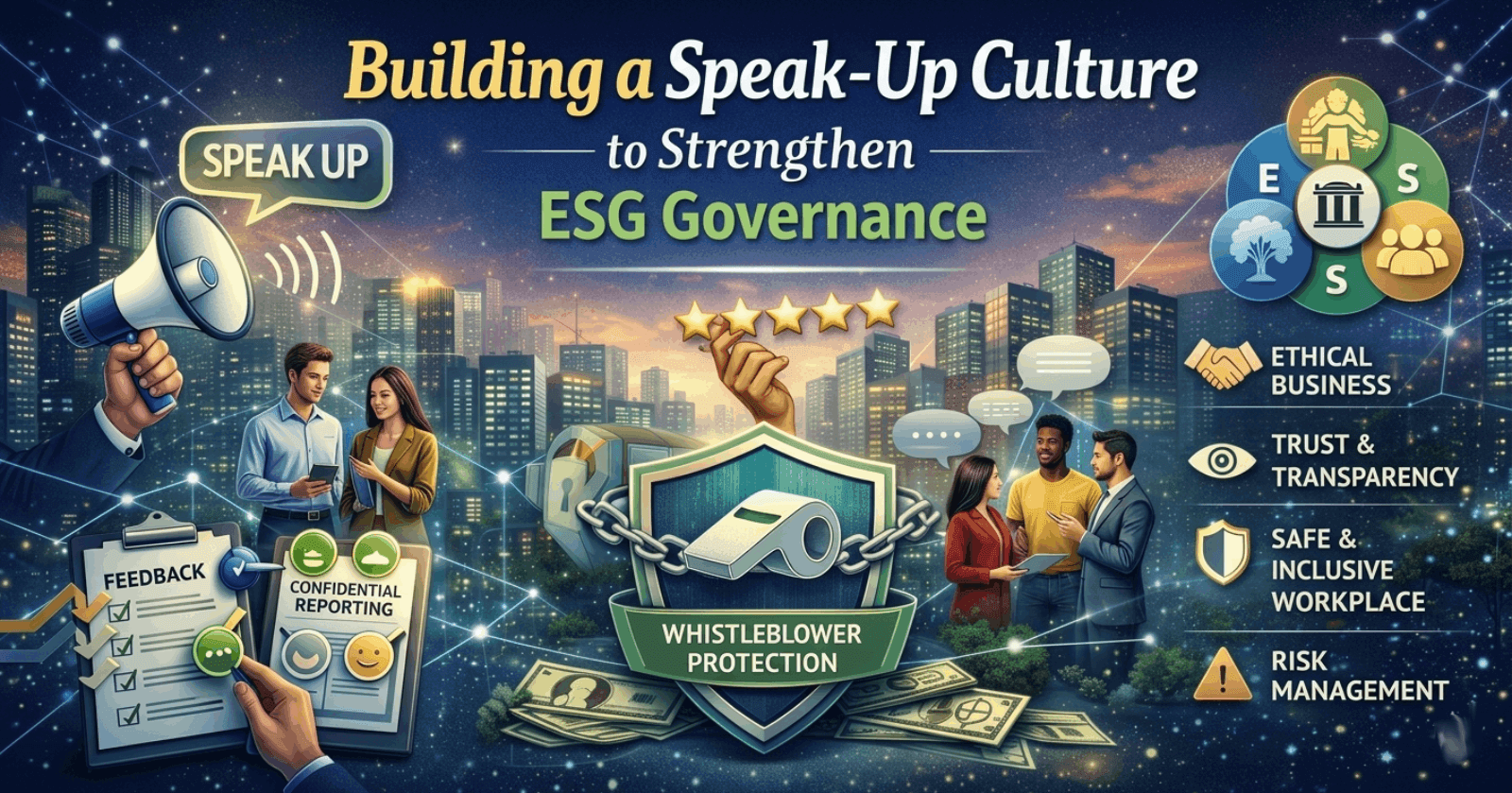
Building a Speak-Up Culture to Strengthen ESG Governance
There is a governance failure in the organisation due to the lack of ESG compliance. They arise when employees identify risks but feel unsafe reporting them. Fraud, harassment, environmental violations, and data manipulation often continue unchecked, not because they are invisible, but because people are silent.
This is why whistleblower protection is no longer a compliance checkbox; it is a governance imperative. Organizations that actively foster a speak-up culture are better positioned to identify risks early, uphold ethical standards, and achieve long-term ESG compliance.
This blog explains why building a speak-up culture matters, the barriers that prevent reporting, the role of leadership and boards, and how organizations can measure the effectiveness of whistleblower systems.
Why Speak-Up Culture Matters for ESG Governance
A speak-up culture is an environment where employees, vendors, and stakeholders feel safe raising concerns without fear of retaliation. In ESG governance, this culture directly influences transparency, accountability, and trust.
Strong whistleblower protection mechanisms help organizations:
- Detect governance failures early
- Prevent regulatory breaches
- Strengthen internal controls
- Demonstrate commitment to ethical leadership
Without credible whistleblower systems, ESG risks remain hidden until they escalate into public scandals, regulatory penalties, or reputational damage, directly undermining ESG compliance.
Cultural Barriers to Reporting
Despite having policies in place, many organizations struggle to implement effective whistleblower protection due to deep-rooted cultural barriers.
Key challenges include:
- Fear of retaliation: Employees worry about career stagnation, job loss, or subtle victimization.
- Lack of trust: Past inaction discourages future reporting.
- Hierarchical structures: Junior staff hesitate to report senior leaders.
- Cultural stigma: Whistleblowing is often wrongly equated with disloyalty.
These barriers weaken the speak-up culture and create blind spots in governance. Without addressing cultural issues, even the most robust reporting channels fail to support ESG compliance.
Leadership and Board Tone
Tone at the top determines whether employees speak or stay silent. Boards and senior leadership play a decisive role in normalizing ethical reporting.
How leadership shapes speak-up culture:
- Leaders openly encourage raising concerns
- Whistleblowers are protected, not isolated
- Investigations are fair and timely
- Outcomes are communicated transparently
This is where ethical leadership becomes critical. When leaders model integrity, accountability, and openness, employees gain confidence in reporting systems. Ethical leadership also signals that whistleblowing supports, not threatens, organizational values.
Boards must actively oversee whistleblower protection, ensuring independence of reporting channels and alignment with global ESG compliance standards.
Measuring Whistleblower Effectiveness
Having a hotline is not enough. Organisations must evaluate whether their whistleblower systems actually work.
Key metrics to assess effectiveness:
- Number of concerns reported over time
- Diversity of reporting sources
- Time taken to investigate and close cases
- Retaliation complaints post-reporting
- Employee perception surveys on safety and trust
A decline in reports may not indicate fewer issues; it may indicate fear. Regular assessment helps strengthen whistleblower protection and reinforces a sustainable speak-up culture.
Measuring effectiveness also helps regulators and investors assess governance maturity and the credibility of ESG compliance.
Board Training & Fair Selection
Boards cannot oversee what they do not understand. Structured board training is essential to embed speak-up principles into governance frameworks.
Why board training matters:
- Improving the whistleblower laws and risks
- Clarifies director responsibilities in investigations of the work
- Strengthens oversight of management actions
- Supporting the governance with ESG expectations
Fair and independent board selection further supports ethical leadership by reducing conflicts of interest. Diverse boards are more likely to question assumptions, support whistleblowers, and demand accountability, which is critical for long-term ESG compliance.
Well-trained boards ensure whistleblower protection mechanisms are not symbolic but operational.
The ESG Compliance Advantage of Speak-Up Systems
Organizations with strong speak-up systems are better equipped to meet regulatory expectations under evolving ESG frameworks.
Effective whistleblower protection:
- Strengthens governance disclosures
- Supports anti-corruption and human rights commitments
- Enhances investor confidence
- Reduces compliance and litigation risks
A mature speak-up culture transforms whistleblowing from a defensive mechanism into a strategic governance asset, reinforcing ethical leadership across the organization.
Wrapping Up
Building a speak-up culture is not about encouraging complaints, it is about encouraging responsibility. Organizations that invest in whistleblower protection, empower ethical leadership, and train boards effectively create resilient governance systems.
A strong speak-up culture enables early risk detection, reinforces trust, and ensures consistent ESG compliance. In an era of rising stakeholder scrutiny, silence is no longer safe, but transparency is sustainable.
Frequently Asked Questions
Why is whistleblower protection critical for ESG governance?
Whistleblower protection ensures that governance, environmental, and social risks are identified early, supporting transparency and ESG compliance.
How does speak-up culture impact ethical leadership?
A strong speak-up culture reinforces ethical leadership by encouraging accountability and integrity at all organizational levels.
What role does the board play in whistleblower systems?
Boards oversee whistleblower protection frameworks, ensure independence, and monitor investigation outcomes to strengthen ESG compliance.
How can companies measure the success of whistleblower programs?
Through reporting trends, investigation timelines, retaliation incidents, and employee trust surveys.
Are whistleblower mechanisms mandatory for ESG compliance?
While requirements vary, most ESG frameworks and regulations increasingly expect robust whistleblower protection as part of good governance.