CBAM: Impact on Indian Exporters
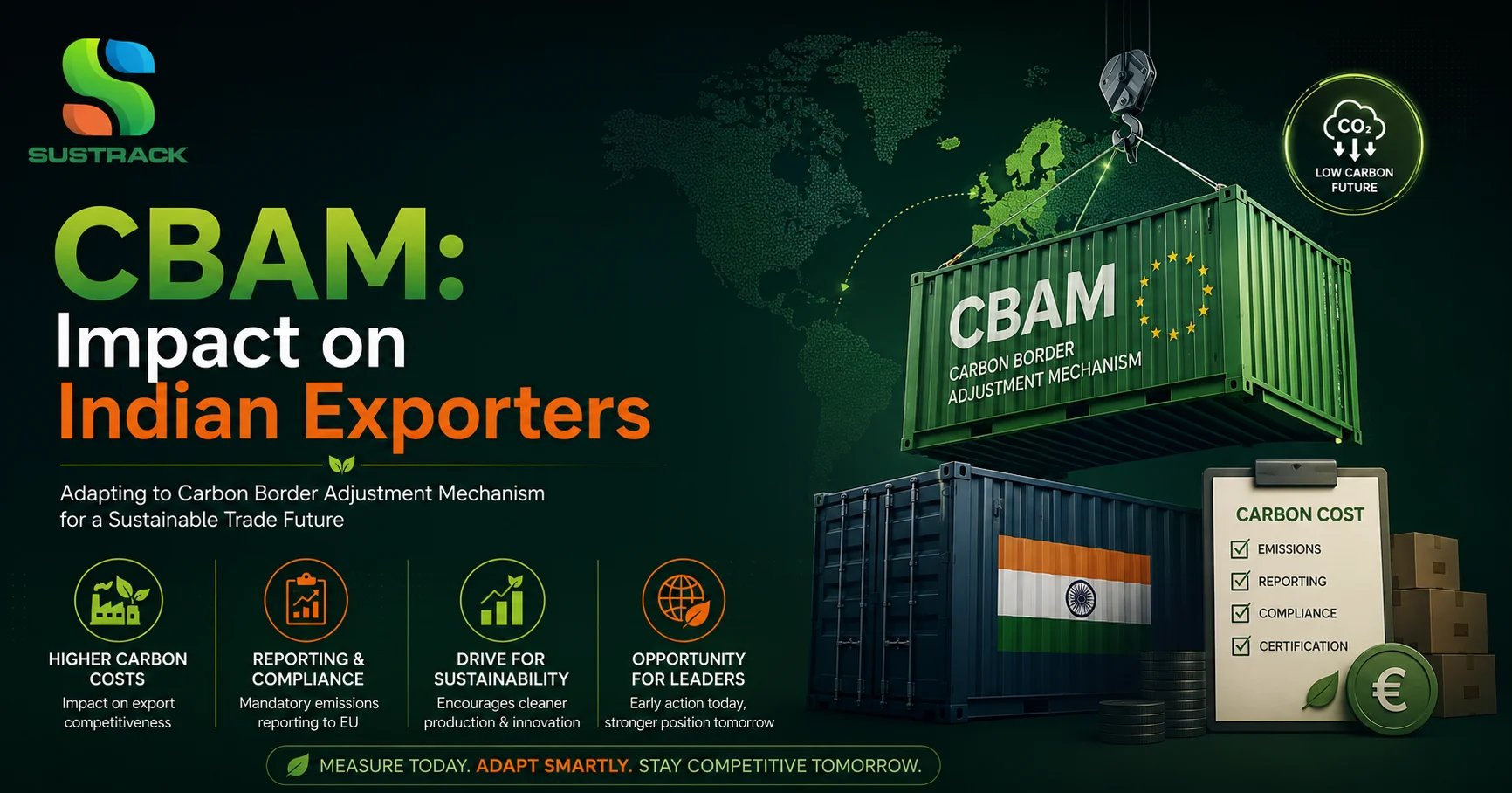
CBAM India impact: The carbon border adjustment mechanism is changing how Indian exporters sell goods to Europe in a simple and direct way.
The carbon border adjustment mechanism is a rule by the European Union that adds a carbon cost on imported products based on how much pollution is created during production. This mainly affects Indian exporters of steel, cement, aluminium, and other energy-heavy products.
CBAM India impact means exporters now need to track and report their carbon emissions clearly. If emissions are high, products may become more expensive in the European market, making it harder to compete.
Companies that reduce emissions will have an advantage because their products will face lower carbon costs and stay more competitive.
Sustrack helps Indian exporters manage carbon border adjustment mechanism requirements by tracking emissions and supporting carbon reporting in a simple and structured way.
What Is Carbon Border Adjustment Mechanism (CBAM)?
The carbon border adjustment mechanism is an EU policy designed to control emissions from imported goods.
The carbon border adjustment mechanism is created to prevent carbon leakage, which happens when companies move production to countries with weaker carbon rules to avoid strict EU regulations.
CBAM India impact means Indian exporters must now measure and report emissions for products like steel, cement, aluminium, fertilizers, electricity, and chemicals.
This works like an EU carbon tax, where importers must pay based on the carbon emissions linked to the product. From 2023, a reporting system started, and exporters must regularly share emissions data with EU importers.
By 2026, the EU carbon tax system will become fully financial, meaning importers will need to buy certificates based on the carbon content of goods. Annual reporting and payments will be required, and free allowances in the EU emissions system will be gradually removed.
Overall, CBAM India impact will increase compliance pressure on Indian exporters but also push them toward cleaner and more efficient production systems.
CBAM India Impact
CBAM compliance requirements are becoming very important for Indian steel exporters, especially those supplying to Europe.
CBAM impact is significant because more than 60% of Indian steel exports go to the European market. This means the CBAM India impact will be strongly felt in the steel sector.
The CBAM is part of export carbon regulations where the EU will charge a carbon fee on imported steel based on its emissions. Since Indian steel is mostly produced using the blast furnace method, it has higher carbon emissions, making it more affected.
CBAM compliance requirements will force exporters to measure, report, and verify their carbon emissions before exporting to the EU. This will become mandatory when the system fully starts in January 2026.
Overall, export carbon regulations like CBAM will increase costs and pressure on Indian exporters, especially in carbon-intensive industries like steel.
Why Sustrack is Important for CBAM Reporting?
As global trade regulations evolve, CBAM is becoming a key challenge for Indian exporters, making accurate carbon reporting and compliance essential for sustainable access to the EU market.
CBAM India Impact on Exporters : CBAM India impact is increasing pressure on Indian exporters to accurately measure, report, and verify carbon emissions. As export carbon regulations become stricter, companies must adopt reliable systems to stay competitive in global markets.
Meeting CBAM Compliance Requirements : CBAM compliance requirements demand detailed carbon reporting at the product level for exports to the EU. Sustrack helps businesses build structured reporting systems that ensure accurate data collection, documentation, and emissions tracking as per global standards.
Supporting Export Carbon Regulations : Under evolving export carbon regulations, exporters must align with frameworks like the EU carbon reporting system. Sustrack provides end-to-end support to simplify compliance and reduce the risk of penalties or trade barriers.
ESG Reporting and Carbon Transparency : Sustrack strengthens compliance through ESG reporting solutions that improve transparency and accountability in carbon emissions data. This helps companies meet international sustainability expectations.
BRSR, ESG Consultancy, and CDP Reporting Support : Sustrack also offers BRSR reporting, ESG consultancy, and CDP reporting services. These services help businesses build strong sustainability frameworks, improve carbon disclosure quality, and stay fully prepared for CBAM-related requirements.
Frequently Asked Questions
What is CBAM India impact and how does it affect exporters?
CBAM India impact refers to the effect of the carbon border adjustment mechanism on Indian exporters, especially those selling to the EU. It increases pressure on companies to measure and report carbon emissions, as high-emission products may face higher costs under export carbon regulations.
What is the carbon border adjustment mechanism and EU carbon tax?
The carbon border adjustment mechanism is an EU policy that acts like an EU carbon tax on imported goods based on their carbon emissions. It is designed to prevent carbon leakage and ensure fair competition between EU producers and international exporters.
What are CBAM compliance requirements for Indian exporters?
CBAM compliance requirements include tracking, calculating, and reporting product-level carbon emissions for exports to the EU. Exporters must maintain accurate emissions data and submit regular reports in line with export carbon regulations, with stricter financial rules starting from 2026.
Which sectors are most affected by CBAM and why is GHG accounting important?
High-emission sectors like steel, cement, aluminium, fertilizers, electricity, and chemicals are most affected due to the CBAM India impact. Strong GHG accounting is essential because it ensures accurate emissions tracking, supports compliance, and aligns with BRSR disclosures, ESG reporting, ESG consultancy, and CDP reporting frameworks.