Scope 1, 2, and 3 Emissions: What Gets Verified in GHG Assurance?
The Sustainability that is driven in today’s world is increasing the pressure on Companies to measure, report, and verify their carbon footprint accurately. The Governments, Investors, and Customers are demanding greater transparency through ESG Compliance and disclosure frameworks. To ensure credibility, Companies that undergo Scope 1, 2, & 3 Emissions Assurance, a procedure that validates the accuracy & completeness of their Greenhouse gas (GHG) data across all GHG scopes.
But what exactly are these scopes, and which ones are typically verified during assurance? Let’s break it down.
What are Scope 1, 2 & 3?
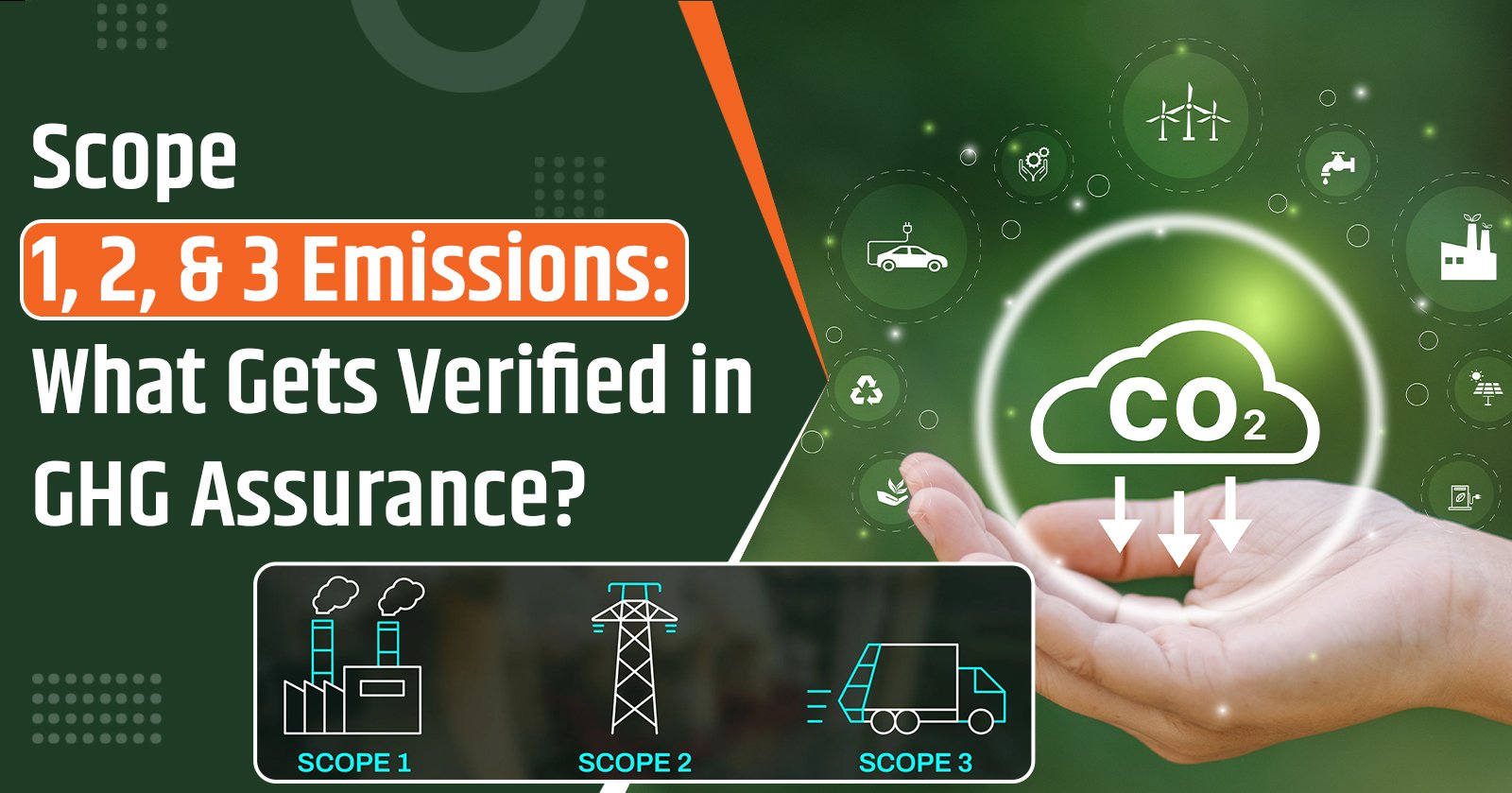
According to the Greenhouse Gas Protocol classification, the emissions are divided into three GHG Scopes to help Organisations identify Direct & Indirect Emissions, the sources that contribute to their Carbon Footprint.
Scope 1: Direct Emissions: Emissions that are produced directly by the company’s sources, such as the fuel combustion in company vehicles, boilers, or generators. For Example, a manufacturing firm that uses diesel trucks contributes directly to Scope 1 emissions.
Scope 2: Indirect Emissions: Scope 2 covers indirect emissions from the electricity, steam, or cooling purchased and consumed by the company. Although the organisation doesn’t produce these emissions directly, they result from energy production elsewhere.
Scope 3: Other Indirect Emissions: Scope 3 emissions are the broadest and most complex. They include all other indirect emissions in a company’s value chain, from raw material sourcing and business travel to product disposal. These often account for over 70% of a company’s carbon footprint, making them a crucial part of Scope 1, 2, and 3 Emissions Assurance.
Which Scopes Are Commonly Verified in GHG Assurance?
In most GHG assurance engagements, companies begin by verifying Scope 1 and Scope 2 emissions, as these are easier to measure with clear operational boundaries and reliable data. Energy bills, fuel records, and meter readings form the basis of verification.
Scope 3, however, is increasingly gaining attention. Many global frameworks, such as ESG compliance standards, the EU CSRD, and the GHG Protocol, now encourage companies to include Scope 3 emissions for a complete picture of their environmental impact. Large corporations and supply chain-intensive industries are now moving toward full Scope 1 2 3 Emissions Assurance.
What are Greenhouse Gas Protocols?
GHG Protocol is a globally recognised standard for measuring and managing Greenhouse gases. It was established in 1990 in response to the demand for a consistent framework for greenhouse gas reporting. The GHG Protocols collaborate with the Government, industries, and companies, where they widely calculate the Gas Emissions.
Challenge of Verifying Scope 3 Emissions
Verifying Scope 3 emissions presents several challenges:
- Complex Supply Chains: Data often spans multiple vendors and geographies, increasing uncertainty.
- Lack of Direct Control: Companies rely on third-party data and estimates rather than actual measurements.
- Data Quality Issues: Inconsistent reporting standards make comparability difficult.
- Estimation Methods: Often, organisations use proxies, spend-based methods, or industry averages to estimate indirect emissions.
Because of these complexities, Scope 3 verification is often limited to high-impact categories like transportation, purchased goods, or business travel, where data reliability can be reasonably established.
Data Sources and Estimation Methods for GHG Scopes
Accurate Scope 1 2 3 Emissions Assurance depends on reliable data collection and estimation. Typical data sources include:
-
Scope 1: Fuel purchase records, vehicle logs, and on-site energy generation data.
-
Scope 2: Utility bills, electricity meter data, and supplier emission factors.
-
Scope 3: Supplier surveys, lifecycle assessments, spend-based databases, and public emission factors.
Estimation often combines activity data (e.g., kilometres travelled, tonnes produced) with standardised emission factors. For robust ESG compliance, organisations must maintain transparent methodologies and audit trails to support their carbon footprint claims.
Assurance Requirements by Regulation
Global regulations are tightening around GHG assurance.
- EU CSRD: Mandates limited assurance for all GHG scopes, expanding to reasonable assurance in later phases.
- SEC Climate Disclosure (US): Requires disclosure and, in some cases, assurance of Scope 1 and Scope 2 data, with Scope 3 under consideration.
- ISSB Standards (IFRS S2): Promote consistency in emissions reporting and verification for investor confidence.
As ESG compliance frameworks evolve, third-party Scope 1 2 3 Emissions Assurance will become a standard expectation for credible sustainability reporting.
TakeAway
Accurate and verified GHG scopes reporting builds trust with stakeholders, enhances transparency, and strengthens an organisation’s ESG compliance standing. While Scope 1 and Scope 2 remain the starting points, forward-thinking companies are embracing full Scope 1 2 3 Emissions Assurance to future-proof their sustainability performance.
Ultimately, the verification process ensures that a company’s carbon footprint isn’t just a number on paper; it’s a reflection of tangible, measurable progress toward a low-carbon future.